Dolores Park sounds:
older gays and gutter-guards
Montana and Wyoming
among her travel must-do’s
robots grooving to techno
international cohort
(super-haiku form)
Dolores Park sounds:
older gays and gutter-guards
Montana and Wyoming
among her travel must-do’s
robots grooving to techno
international cohort
(super-haiku form)
This morning, for the first time since I can remember, I went to Saturday morning religious services, with my mother and brother, at his conservative Jewish temple in Bethesda, MD. We walked there, like good Jews, echoing the more Conservative practice of not working (nor driving cars) on the Sabbath.
With decades of distance between me and any practice of organized religion — other than as a tourist at the Blue Mosque in Istanbul, or at a ceremony and celebration of life those recently and dearly departed — I had fresh eyes to observe some particulars of Jewish religiosity.
First, some context: There were about 50 people in the sanctuary, socially distanced and masked, in a space that could hold 250. The two hour service consisted of Torah readings, singing, chanting, and a guest sermon from a Rabbi delivered via Zoom.
While there was one main focus — say, this morning’s reading from the book of Numbers — there were many other distractions: the Rabbi walking off the bema (altar) into the congregation inviting someone spur-of-the-moment to do a reading; people talking with each other at what they thought was low volume, and hugging and kissing; people standing up and walking out, or new people arriving. The Conservative and Orthodox traditions also feature davening, what sounds like murmuring, looks like rocking back and forth, and is an an individual response to the Rabbi’s call.
It’s not like a play or movie with a quiet, rapt audience, nor like a classical music or stage performance that attempts to minimize interruptions by clustering attendees at an entrance until a segment is complete. In fact, it felt more like participation, interruptions, and commentary are expected.
One page from the Bomberg Talmud
Maybe even required, given the actual content of the service and structure of sacred Jewish texts. The Torah and the haftorah both contain commentary and footnotes. The Talmud — the most holy of Jewish books, the genesis of Jewish laws, and the primary source of rabbinical training — has a page layout that accommodates source material, no fewer than five sources of commentary on the source material that’s been compiled over the centuries, two sidebar locations to cross-reference other material, and even printer’s notes [see image]. So it’s not surprising that one Saturday service, even after years of absence, would embody this hodgepodge of simultaneous commentary and confusion.
I was raised in the Reform tradition and became a Bar Mitzvah at the traditional age of 13. Although that ceremony marks the transition out of boyhood, it wasn’t until years later that I became free to make my own decisions about religion. What I appreciate about Jewishness is the space created, in texts, for interpretations of the stories, allowing for resonance and meaning. With that approach as my guide, what follows are some of the traditions I appreciate:
On most Friday nights after a long week of work, a delicious candle-lit dinner, and a special grace-like blessing over food and wine becomes Shabbat.
Even as a kid I loved Sukkot, the agriculturally-oriented harvest holiday, where you hold woven-together palm fronds, willow branches, and a myrtle bough in your hand, along with the fruit of a citron tree, and wave them north, south, east, and west, to honor and bless mother earth.
Tzedakah, in my interpretation, is giving — typically financial donations — to those less fortunate, and without expecting anything in return. Sounds like the gift economies of a certain burning man I know, and generally exuding kindness.
Music. Because I was born in the 70s, I have many memories of singing Jewish religious songs in small groups accompanied by guitar and clapping, in lieu of the more formal professional cantor or organ. Even this morning I could recall many of the melodies, and I’ve written previously about my experience singing my Torah portion.
Food. Grandma Mollie’s chicken matzoh ball soup, Grandma Moo’s brisket, hamantaschen cookies, pastrami on marbled rye with mustard, rugelach of any variety (but mostly the apricot walnut ones from La Farine), and on and on.
Count the seconds between Lightning and Thunder, L comes before T and that determines how far you are away. Alice calls crying. He’s lost it all, he had it but he has lost it — all of it. You travel back to the place, the very spot, you’ll be flooded with remembrances. Count the hours, the years. I’ll be 50, he’ll be 37. We respect each other, we push each other but not past comfort, of a Kind. I get all the questions and I see all the inconsistencies, always. It’s always shocking when it shows, those. She’s further away now. His voice, always turning on the sweet, where is that accommodation for me? I’m difficult. I require communication. Talk, since you’re here. Talk, tell me everything. The more I know the more I can do. It’s a kind of never-forgetting, also a kind of learning. It’s summer. I want to learn new things about old places. Let’s go back to some together, for the first time. The rain is blocking the moon, but I know it’s full.
long before this time this
pile of rock in front of us
had a different name,
long before us its name
meant another thing. we claim
our time with names. each name,
one life. other times, other names.
another epoch, another time.
our time isn’t named yet –
someone else’ll do that later.
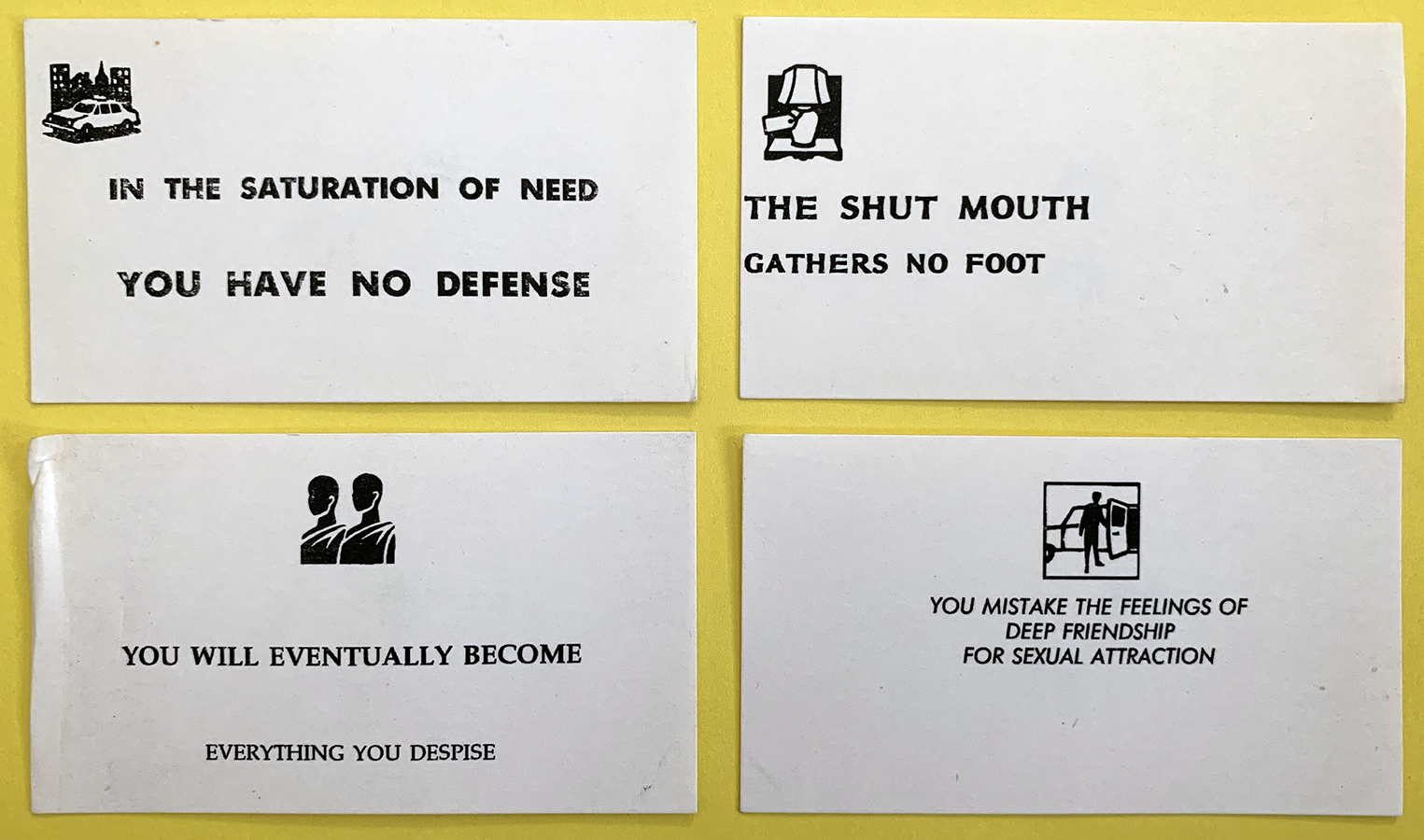
Boston, Massachusetts, circa 1996. The Fenway neighborhood where I live is seeing more development on Boylston Street. One of the new stores is an independent office supply shop. Naturally, I walk in, and discover an instant business card machine, $5 for 20 cards laser printed in one color. Using the machine’s terrible UI (boy I wish I’d documented that), limited typographic choices and oblique clip art, I assemble a series of messages – life tips, really – to hand out to people or install in public places (ads on the T, included with restaurant cheques).
I’ve always been inspired by Jenny Holzer’s work, and was channelling her tone and style with my own content and in a new form. I kept one of each of the many cards I made over the years; these are the first four.
It is an honor to assume the Chair of the Master of Interaction Design program. I am humbled and grateful for the support of Dean Helen Maria Nugent, Provost Tammy Rae Carland, Associate Provost Julie Kirgis, and Senior Manager Christine Lasher. I am thankful, too, for the support of the selection committee, student committee, faculty, staff, and students. I look forward to collaborating with the entire CCA community as we continue building a world-changing institution.
The opportunity to serve you comes during an unprecedented time – a time of tremendous social anxiety, health concerns, economic uncertainty, job loss – and I must first acknowledge the disconnect of entering a new role while tens of millions have lost theirs.
Many, if not all of us, are experiencing disruption. Beliefs and traditions upon which we built our lives and livelihoods are crumbling. New behaviors and protocols have been introduced with little preparation and without means to uphold them. The global crisis is revealing the interconnectedness and interdependencies of our systems, and how different leaders respond and react as we try, each day, to find ways to safely navigate through it.
It may feel like the world as we know it is ending. While our planet takes a breath, perhaps what is ending are our existing methods of existence.
We are constrained to turn inward now and live on the inside. We may find ourselves reflecting on this massive transition, asking: was our old world serving us all, equally? Likely not. So what’s next?
As we try to navigate this change, as we acclimate and begin to adjust, we find ways to share the experience. A chorus of neighbors sing the same song from their porches. Video calls include high fives to suggest touch. New Yorkers cheer for healthcare workers at 7 o’clock every day. Barter economies re-emerge – skill for skill, person to person. Each positive action feels like a triumph, and each sign of renewal begets hope for further regeneration.
There is and will continue to be great loss. For people, jobs, traditions, rhythms of a former life, we need ample time and space to grieve and process.
Yet as you grieve, as you process, as a designer you may find you have a parallel feeling – one for which your training has prepared you. To find possibility in catastrophe. To work with unfamiliar constraints, to help define them, and then respond to them. To sustain the aspects of life and society that are successful, and work to reinvent the myriad things that will need reinvention. To bring a fully human perspective to means of interaction that are now more consistently digital. And to work through and help others work through their fear with creativity.
At the core of this crisis is human need. When you are ready, there is an unlimited amount of work to do. The challenges we face require education, patience, care, and ongoing support. Plus they will require funding, partnerships, and unprecedented collaboration. We will need to envision, design, and build new systems and services. We will need to invent new methods and models, apply them, and learn from them.
When you are ready, let us co-create together.
this time
the upward slope
of daily numbers –
each one –
without touch.
without goodbye,
many will die.
this, this is how
we finally know
our connectivity,
thanks to exponents.
at the all clear
we will hear
the joy of a crowd
enjoying, yes
when the all clear comes
may we know
how to say hello,
our neighbors’ names
each storied one.
When you are under something, it is above you.
In order to see it, you look up at it.
Looking up at a thing can mean you revere it, you honor it.
Provided it’s not weighing you down (and for this hypothesis), you naturally support something you are under. You humble yourself and are in deference to it. And if you love it, you serve it.
By contrast, being over something means it has transpired for you.
Dismissed to the point of eye rolling. Cancelled, even.
When you are standing over something, it is beneath you. Smaller than you.
When it is beneath you, it’s likely that you feel bigger than it.
※
For today, a moment of reflection of this year — my over and under.
I had a full year of independent self-employed work: 100% of the marketing and in-bound business was driven by me or my network. It’s taken years of living in the Bay Area for this network to be supportive in this way, and it’s a critical component of self-employment. My network from living back east for half of my life (Boston, Providence, New York) continues to create work opportunities, as does my continued involvement with AIGA and more recently the StartOut and Queer Design Club communities.
This year has been a mix of shorter term operations consulting (months); longer term operations consulting (almost the whole year, plus some carry-over from 2018); coaching design leaders in team strategy and collaborative innovation approaches; teaching a class at CCA; speaking in South Dakota, Seattle, Helsinki, and Toronto; workshops, both in conjunction with conferences and independently; guest critiques in San Francisco and Seattle; and a few visual design and rebranding projects for private clients. Some of the time I’m a brand designer; others, I’m an organizational therapist.
I am grateful and humbled by — in other words, under — the ways in which networking and building relationships, each at different vectors or orbits, has brought possibilities, and then how some of these have turned into engagements. As one example, I met Alla Weinberg years ago when we were both at General Assembly. She then went on to work at Salesforce, and recommended me for a long-term consulting engagement there, helping the Business Technology Innovation Team start their operations practices. When Alla was formalizing a new, independent coaching venture, Margot Bloomstein and I teamed up with Alla and her business partner Duncan to strategize, position, and brand Spoke + Wheel. Even though 3 out of 4 of the project team had collaborated in the past and had great rapport, there was an additional, palpable fluidity because we were branding a coaching and team optimization practice with a shared humility.
There are other examples: My CCA students who learned how marketable and employable their multidisciplinary talents truly are, and how to tell the story of their work. Or the participants of a workshop at a private equity firm, where marketing and sales teams hadn’t clearly aligned on their target customer, and had a small transformation in a few hours, resulting in the notion they should “do this more often.” And the faculty and staff of the NYU Gallatin School, who hired me to help them with their internal operations and later came to realize they need help telling their own story. In these and still other cases, it’s not solely or simply about being kind, asking bigger picture questions, doing the work you’re hired for, or even networking and making connections. It’s a fundamental difference of approach to serving, lifting up. This shift contains the magical additional power of allowing yourself to feel valuable.
※
I’m over feeling not valuable, or believing I’m not valuable. I occasionally feel this become self-fulfilling; thinking you’re not valuable can lead to empty words or pat advice. Or worse, saying the thing others expect you to say. I’m over not feeling able to push through self-doubt to say what I feel, speaking from my heart and instinct.
I’m over working in environments where fear and favoritism are palpable, where my physical self can pick up on this and become triggered. Where politics and nepotism are the drivers of decisions. What’s worse is when there’s no openness to self-assessment, evolution, positive change.
I’m over work environments favoring the what when where and how, before there’s time and consideration for the who and why.
There were a few opportunities this year that fizzled out, from postponing a kickoff, misaligned expectations or priorities, or general entropy. If there was interest or budget but then priorities changed, I have always inquired what influenced the change. Sometimes I learn and other times it’s empty word salad.
That said, I’m simply beyond feeling like it’s too late to do something you want to start yourself. If you’re alive and reading this, it’s not too late.
Approach it with respectfulness and intention, and that will allow others to get behind it.
I’m not sure what the cultural derivation of it is, but Jews seem to have an extraordinary relationship with napkins. We’re somehow always prepared with one. In our pockets, packets in our purses and backpacks, here’s my handkerchief, no take it, use it. The set of good white thick cotton napkins for special meals in its own ziploc. (I have mine.) Or the square orange cloth napkins with the embroidered edge that Caitlin brought back from India, all four of which I still have. The small gray linen ones that were on sale. Where does this come from? Is it a form of Goy Scout preparedness?
I’d like to research the graphic and cultural history of smiles – abstract, illustrative, and photographic – in brands.
During these days of violence, optimism is in short supply and the simplest gentleness is almost a surprise. As I was going through my vinyl last night and organizing it, inside one of the classical box sets I found a program, from 1965, for an afternoon event at the Kresge Auditorium at MIT. On the bottom of the page, there’s a handwritten note. Its author uses a decidedly lazy, almost cryptic hand to scrawl a passing thought:
When we are gentle to each other
I feel as if gentleness could hold the world
In my experience coaching thoughtful senior leaders, it seems to me that, when you move beyond just being someone who sorts finances and rotas and so on, a large part of being a leader is learning to exist within unresolvable or cyclical tensions.
Here are four that seem particularly relevant for people starting to build a bigger team, grow their organisation or become more conscious as leaders.
As you develop as a leader, you tend to be comfortable with either direct, controlling power or space-holding, allowing power. Search your soul to see if you can find why you don’t like the other type.
Practice the other style. Work on just having a small part of the truth and finding the rest of the truth through trusting others’ perspectives. Or work on being clearer about your own perspective if you find it tough to communicate what you think and stick to it.
In addition, how are you moving towards mutual power, shared responsibility, distributed decision-making whilst holding enough structure for everyone in the business to function?
You’re always going to be excluding some people. You decide if you’re excluding people who are more marginalised by society or people who are unwilling to drop their internalised dominance. Inclusion, equity, and justice aren’t about everyone being safe and valued, but the most marginalised in society being safe and valued.
It’s not enough to be ‘nice.’ Educate yourself on aspects of identity where you are in the dominant narrative. If you’re white, educate yourself on white supremacy and racism. If you’re a non-trans man, educate yourself on misogyny and feminism. If you’re not trans, educate yourself on transphobia and the gender binary. If you’re not disabled (yet), educate yourself on disability rights, universal access and ableism. If you’re not LGBQ, educate yourself on LGBQ rights and heterocentrism.
Your instincts aren’t enough. Unconscious bias is very real, but unconscious bias ‘training’ is 1% of what’s required to undo its lifelong effects.
Just google ‘[term] 101’ and read ten articles to start with. Or ‘[term] reading list’ and get (and read!) some books. Particularly read books and articles by Writers of Colour. Do that before you start asking people you know to educate you.
Your instincts aren’t enough. Unconscious bias is very real, but unconscious bias ‘training’ is 1% of what’s required to undo its lifelong effects.
Consider who’s in your leadership team and early hires. Those are the people who are going to significantly affect the makeup of your organisation.
It’s fine that you and your organisation is working on breaking down your internalised programming, just be clear where on your journey you’re at, on your website, in your job ads and during your hiring process. If you’re hiring someone from a specific demographic and they’re the first, tell them that. They’ll probably already know.
Decide where your bottom line is in terms of code of conduct — what is totally not acceptable in terms of behaviour and what are the repercussions for breaking the Code of Conduct. Take a stand that is coherent with where you genuinely are. Make it public and it’ll attract some people and put off others.
There is a difference between aspirational ‘espoused’ values and values-in-action. This gap is just a fact of life. Don’t wait to be given feedback on it — be the one who opens up a channel for candid dialogue. Stone and Heen, the authors of Thanks For The Feedback, say the one factor that most affects if an organisation is a learning organisation is the way the senior team receives feedback.
Model the values you want the team to live. Go there first. For example, don’t work 15 hour days and then lecture them about burnout. (This is the tension of care vs capitalism, I suppose.)
Public leadership is presentations, meetings, conversations and so on. Private leadership is your awareness of timelines, patterns, empathy, power, your awareness of your own awareness itself.
Work on both. Sometimes one is more in your control than the other. Sometimes when what you’re doing feels out of your control, all you can do is to work out who you want to be today.
Who do you want to be, by the way?
When a leader joins a new team, there’s a common phrase that’s used, “inheriting a team.” Inheritance is right...and wrong.
It’s right, in part, because the team is something someone else has built up before you, and now it’s transferred into your responsibility. It’s wrong because inheritance implies possession. Now you own it. This is a terrible frame of mind for someone joining a team. Which is precisely how I like to think about it at first: “joining the team.” The team leader is a member of the team.
The First 90 Days by Michael Watkins is often recommended reading for people taking on new roles: whether in the same company or in a new company. I’d never read it before my latest professional transition. I wish I had. It’s full of practical advice and frameworks for thinking about entering a new role and decreasing the timeline between you being a cost to you being a value-add to the organization. I particularly liked Watkins’s recommendations around accelerated learning and spotting blind spots.
I found quickly in my new role leading design at a 6.5 year-old start-up that the complex market environment, state of the team, and company priorities pulled me in many directions. Each direction was some pull away from my well-formed plan. Frameworks in a book and frameworks applied to daily work are two different things. It reminded me that the main value of planning is the act of planning itself. It’s not as much about sticking to the plan as it is having planned and then having the plan as a solid place to deviate from, as opposed to being pushed around by the winds, ungrounded. I’ve been thinking about this a lot, and have formed a talk about it that I’ll be presenting at Leading Design: London.
This realization returned me to some other fundamentals, most strongly: setting expectations.
Expectation-setting is critical. Set expectations in a 90 day plan, in a statement of intent, in a vision essay, or in a hundred small conversations. Whatever you do, you have to set expectations. They should be inspiring (not necessarily in their ambition, I think that depends on the organizational context), but at minimum in their evolution beyond what existed before.